Steam turbines are essential equipment in thermal power plants, industrial power generation facilities, and large process industries. They convert the thermal energy of high-pressure steam into mechanical energy, which is used to drive generators and other industrial machinery.
A steam turbine system consists of several components that must operate reliably under demanding pressure, temperature, and operating conditions. Industrial castings play an important role in supporting these systems, particularly in housings, casings, valve bodies, bearing supports, and other structural components.
Selecting suitable casting materials, manufacturing processes, and machining requirements is essential for achieving the required component quality and dimensional accuracy.
What Are Steam Turbine Castings?
Steam turbine castings are components produced through metal casting processes to achieve specific shapes and engineering requirements. They are used in different parts of turbine assemblies and their supporting equipment.
Depending on the design and operating conditions, these components may require specific material properties, dimensional tolerances, pressure resistance, and surface finishing.
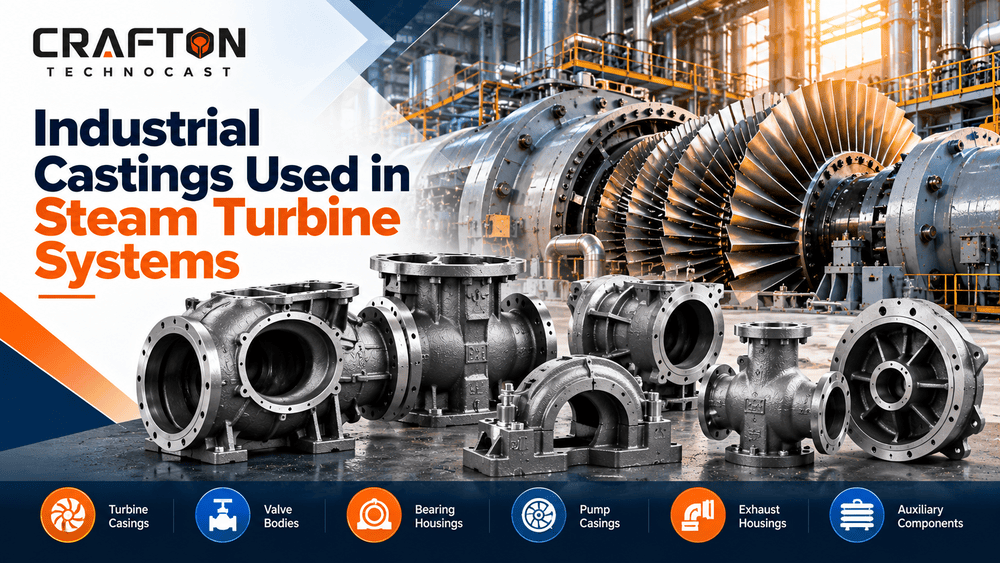
Common casting applications include turbine casings, valve bodies, bearing housings, exhaust housings, and auxiliary equipment components.
Major Industrial Castings Used in Steam Turbine Systems
1. Steam Turbine Casings
Steam turbine casings form the outer enclosure around important internal turbine components. They help contain steam and provide structural support for the turbine assembly.
These components require careful design, material selection, and machining to meet the specified operating conditions.
2. Steam Valve Bodies
Steam valve bodies are important parts of turbine steam control systems. They house valve mechanisms that regulate steam flow according to system requirements.
Casting quality, material suitability, and dimensional accuracy are important considerations in their production.
3. Bearing Housings
Bearing housings support and protect bearing assemblies used in rotating machinery. They help maintain the required bearing arrangement and alignment.
Depending on the application, these components may require accurate machining, suitable material properties, and reliable structural performance.
4. Exhaust Housings
Exhaust housings are used in turbine arrangements to guide steam towards the exhaust section or connected equipment.
Their design depends on turbine configuration, flow requirements, operating conditions, and equipment specifications.
5. Pump and Auxiliary Equipment Casings
Steam turbine installations also include auxiliary systems such as lubrication, cooling, condensate handling, and water circulation.
These systems use different industrial cast components, including pump casings, valve bodies, and equipment housings.
6. Support and Structural Components
Certain supporting components used in turbine installations can also be produced through casting, depending on their design and loading requirements.
These parts help accommodate equipment mounting, positioning, and structural support requirements.
Why Casting Quality Matters in Steam Turbine Applications
Steam turbine systems operate under demanding conditions, making component quality an important consideration.
Poor casting quality or dimensional inaccuracies can lead to assembly difficulties, additional machining, rework, or component rejection.
A controlled manufacturing process helps achieve:
Consistent material quality.
Accurate component dimensions.
Reliable machining interfaces.
Reduced casting defects and rework.
Better manufacturing consistency.
Compliance with customer drawings and specifications.
For critical pressure-containing and high-temperature components, the required inspection, material certification, and manufacturing standards must be established before production.
How to Choose an Industrial Casting Supplier for Steam Turbine Components
Selecting the right casting supplier is important for power generation equipment manufacturers and industrial buyers.
Before placing an order, consider the following:
Experience with similar industrial casting components.
Availability of suitable casting processes.
Material testing and quality inspection facilities.
Machining capabilities for critical dimensions.
Ability to follow customer drawings and specifications.
Traceability and quality documentation.
Production capacity and delivery commitments.
A supplier’s capabilities should be evaluated against the specific component requirements rather than general casting experience alone
Why Choose Crafton Technocast?
Crafton Technocast specializes in Lost Foam Casting and precision-engineered industrial cast components.
Our product capabilities include:
Industrial Pump Castings, Industrial Valve Castings, Automotive Casting Components, Pipe Fittings, Fire & Safety Equipment Castings, Pneumatic Components, and Power Plant Equipment Castings.
We work with customer drawings and technical specifications to develop components based on application requirements, material selection, production volume, dimensional requirements, and quality expectations.
Our focus is not simply on producing a casting. It is on finding a manufacturing solution that works for the complete production requirement.
Contact Crafton Technocast
If you are searching for a reliable engine block casting manufacturer in India, Crafton Technocast provides high-quality CI and SG Iron castings for industrial applications.
We are committed to delivering precision, quality, and advanced engineering solutions for global industries.
Contact us today for customized industrial casting solutions.
Add comment