
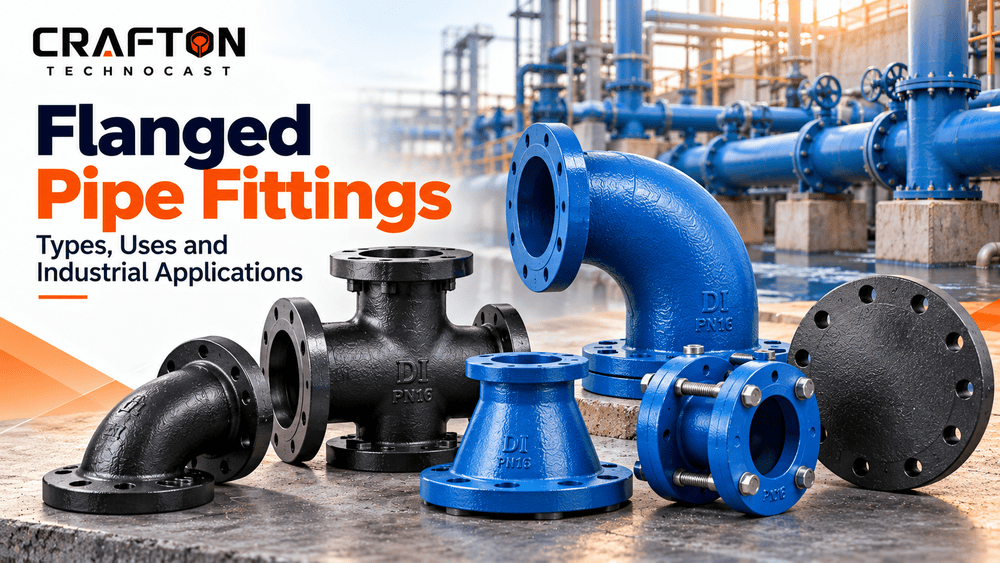
Flanged pipe fittings are essential components used in industrial piping systems to connect pipes, valves, pumps, and other equipment securely. They provide detachable connections that make installation, maintenance, inspection, and replacement easier. These fittings are widely used in water supply networks, wastewater treatment plants, industrial pipelines, power plants, and various infrastructure projects.
Cast Iron (CI) and Ductile Iron (DI) flanged pipe fittings are commonly selected for applications requiring reliable mechanical performance and long-term service. Their design, material grade, pressure requirements, flange dimensions, and surface protection play an important role in ensuring the performance of a piping system.
What Are Flanged Pipe Fittings?
Flanged pipe fittings are piping components designed with flange ends that allow connections using bolts, nuts, and suitable gaskets. The flange creates a bolted joint between two piping components, allowing the connection to be dismantled when required.
Depending on pipeline design and application requirements, flanged fittings are available in different shapes, sizes, and configurations. They are manufactured using materials such as cast iron, ductile iron, stainless steel, and other suitable alloys.
Types of Flanged Pipe Fittings
Different types of flanged fittings are used to accommodate pipeline layouts, directional changes, branch connections, and installation requirements.
1. Flanged Bends
Flanged bends are used to change the direction of fluid flow within a pipeline. They are available in different angles, including 90-degree and 45-degree configurations, depending on system requirements.
2. Flanged Elbows
Flanged elbows connect two pipe sections at an angle. They are commonly used in water distribution networks, pumping stations, and industrial piping systems where changes in pipeline direction are required.
3. Flanged Tee Fittings
Flanged tees allow a branch connection to be created from the main pipeline. They are available in equal and reducing configurations to accommodate different pipeline sizes and flow requirements.
4. Flanged Reducers
Flanged reducers connect pipelines of different diameters. They help transition between larger and smaller pipe sizes while maintaining the required piping arrangement.
5. Flanged Adaptors
Flanged adaptors are used to connect different pipe ends or piping components. They are particularly useful in pipeline installation, repair, and connection applications.
6. Blank Flanges
Blank flanges are solid flange components used to close or isolate the end of a pipeline. They are useful for maintenance, pressure testing, and future pipeline extensions when designed for the applicable service conditions.
7. Flanged Puddle Pipes
Flanged puddle pipes are used where pipelines pass through concrete walls or structures. Their design helps provide a secure pipe penetration arrangement and can assist in limiting water seepage around the penetration when properly installed and sealed.
Industrial Applications of Flanged Pipe Fittings
Flanged pipe fittings are used across several industries because they provide practical connections for pipeline installation and maintenance.
1. Water Supply Systems
Flanged bends, tees, reducers, and adaptors are used in municipal water distribution networks, pumping stations, and water transmission pipelines.
2. Wastewater Treatment Plants
These fittings are used in wastewater collection, treatment, and discharge systems. Material selection and suitable protective coatings are important depending on the wastewater characteristics.
3. Industrial Processing Plants
Manufacturing facilities use flanged fittings to connect pipelines, pumps, valves, and process equipment.
4. Power Generation Facilities
Piping systems in power plants use different flanged components for water circulation, cooling systems, and other utility services, subject to the operating requirements.
5. Fire Protection Systems
Flanged fittings are used in suitable fire protection piping networks to connect different pipeline sections and equipment.
6. Irrigation and Agricultural Infrastructure
Water distribution pipelines in irrigation projects use flanged bends, tees, reducers, and adaptors to manage pipeline direction and connections.
Important Factors When Selecting Flanged Pipe Fittings
Choosing the right flanged fitting is essential for pipeline safety, performance, and service life. Buyers and project engineers should consider the following factors:
Material grade: Select a material suitable for the operating environment and project specifications.
Nominal diameter: Confirm the required pipe size and connection dimensions.
Pressure rating: Ensure that the fitting and flange are suitable for the system’s design pressure.
Flange drilling: Check bolt-hole arrangement, pitch circle diameter, and flange dimensions against the specified standard.
Gasket compatibility: Select suitable gasket materials and joint arrangements for the fluid and operating conditions.
Surface protection: Consider appropriate coatings or linings based on corrosion exposure and service requirements.
Dimensional inspection: Verify critical dimensions, alignment, and connection compatibility before installation.
How Are Cast Iron and Ductile Iron Flanged Fittings Manufactured?
The manufacturing process generally involves several stages to achieve the required component shape, dimensions, and quality.
Design and pattern preparation: Component drawings and patterns are prepared according to the required dimensions and design.
Molding and core preparation: Molds and cores are prepared to create the required component geometry.
Melting and pouring: The selected material is melted and poured into the prepared mold.
Cooling and fettling: After solidification, the casting is removed, cleaned, and finished.
Machining: Critical surfaces, flange faces, and bolt holes are machined according to specifications.
Quality inspection: Components undergo dimensional and other applicable material and quality checks.
Surface treatment: Suitable coating or lining is applied where specified.
The exact manufacturing route depends on the component design, material, casting process, and customer requirements.
Using Casting Design to Improve Efficiency
Good component design can contribute significantly to sustainable manufacturing. Design reviews can identify opportunities to reduce unnecessary material, simplify geometries, and improve manufacturability.
Depending on the component, casting simulation and engineering analysis may help identify potential filling or solidification problems before production begins. This can reduce trial runs, avoidable rework, and material loss.
Collaboration between customers and foundry engineers during the design stage can help balance component performance, manufacturability, and cost.
Why Choose Crafton Technocast?
Crafton Technocast specializes in Lost Foam Casting and precision-engineered industrial cast components.
Our product capabilities include:
Industrial Pump Castings, Industrial Valve Castings, Automotive Casting Components, Pipe Fittings, Fire & Safety Equipment Castings, Pneumatic Components, and Power Plant Equipment Castings.
We work with customer drawings and technical specifications to develop components based on application requirements, material selection, production volume, dimensional requirements, and quality expectations.
Our focus is not simply on producing a casting. It is on finding a manufacturing solution that works for the complete production requirement.
Contact Crafton Technocast
If you are searching for a reliable engine block casting manufacturer in India, Crafton Technocast provides high-quality CI and SG Iron castings for industrial applications.
We are committed to delivering precision, quality, and advanced engineering solutions for global industries.
Contact us today for customized industrial casting solutions.

Add comment