
Lost Foam Casting for Automotive Components
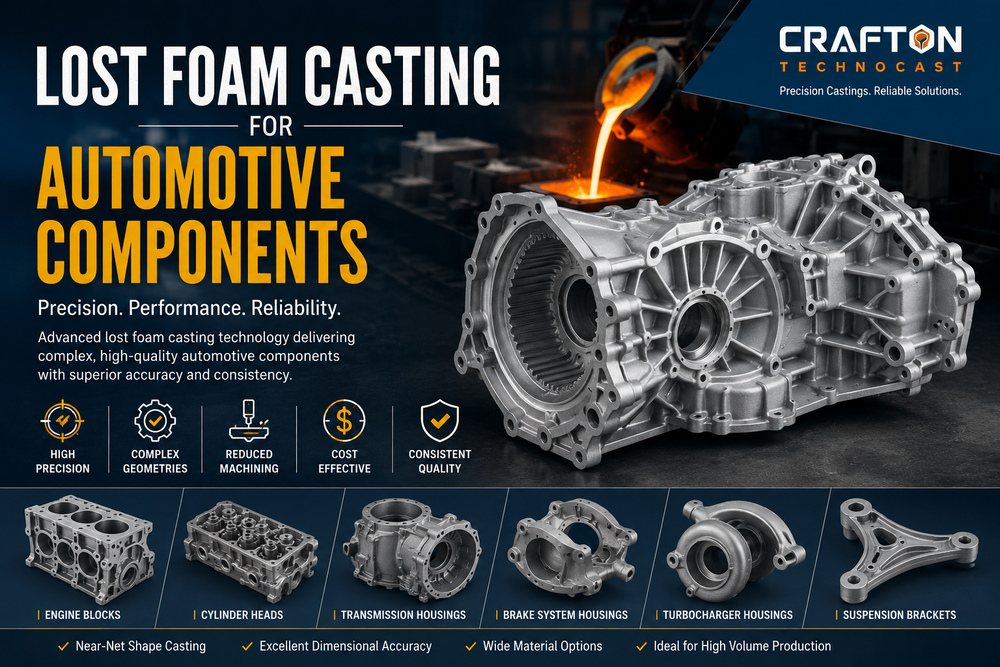
The automotive industry is evolving rapidly, driven by the demand for lighter vehicles, improved fuel efficiency, electric mobility, and higher manufacturing precision. As vehicle designs become more complex, manufacturers require production methods capable of delivering intricate metal components with consistent quality and reduced production costs. Lost Foam Casting for Automotive Components has emerged as one of the most advanced manufacturing technologies, enabling automotive manufacturers to produce highly accurate and complex castings while minimizing machining and assembly operations.
Unlike conventional casting methods, Lost Foam Casting offers greater design flexibility, improved dimensional accuracy, and near-net-shape production, making it ideal for manufacturing critical automotive components. From engine blocks and transmission housings to brake system housings and turbocharger casings, the process supports the production of durable, high-performance parts that meet the stringent requirements of modern vehicles.
As global automotive manufacturers continue to focus on efficiency, sustainability, and precision engineering, Lost Foam Casting has become an essential process for producing reliable cast components used in passenger cars, commercial vehicles, agricultural machinery, heavy equipment, and electric vehicles.
Why the Automotive Industry Prefers Lost Foam Casting
The automotive sector demands manufacturing processes that can deliver precision, repeatability, and cost efficiency without compromising component performance. Lost Foam Casting addresses these requirements by allowing manufacturers to produce complex parts with fewer production stages and tighter dimensional tolerances.
One of the primary advantages is the ability to manufacture near-net-shape components. Since the casting closely matches the final product dimensions, less machining is required, reducing production time and material consumption. This not only lowers manufacturing costs but also improves productivity.
Another significant benefit is the ability to produce intricate internal passages and complex external profiles as a single casting. Components that previously required multiple castings, welding, or extensive assembly can now be manufactured as one integrated part. This enhances structural strength while reducing the risk of assembly-related defects.
Manufacturing Process of Lost Foam Casting for Automotive Components
Producing high-quality automotive castings requires a carefully controlled manufacturing process. Every stage contributes to the accuracy, strength, and reliability of the finished component.
The process begins with the design of a foam pattern using advanced CAD software. Engineers create an exact digital model of the automotive component, ensuring that all critical dimensions and functional features are incorporated into the design. This model is then used to manufacture an expanded polystyrene foam pattern that replicates the final component.
The foam pattern is assembled and coated with a refractory material that improves surface quality and supports gas permeability during metal pouring. Once dried, the coated pattern is placed inside a moulding flask and surrounded by dry, unbonded silica sand. Controlled vibration compacts the sand around the pattern, providing the necessary support without using chemical binders.
Molten metal is then poured into the mould. The heat from the molten metal vaporizes the foam pattern, allowing the metal to occupy the exact space previously filled by the foam. As the metal cools and solidifies, it forms a highly accurate automotive casting with minimal dimensional variation.
After solidification, the casting undergoes fettling, heat treatment where required, precision CNC machining, and comprehensive quality inspection. Each component is carefully verified to ensure compliance with customer drawings and international quality standards before shipment.
Automotive Components Manufactured Using Lost Foam Casting
One of the greatest advantages of Lost Foam Casting is its ability to manufacture a wide variety of complex automotive components with excellent dimensional accuracy. These components are used in passenger vehicles, commercial vehicles, off-highway equipment, and electric vehicles.
Engine Blocks
Engine blocks are among the most demanding automotive castings due to their complex internal coolant passages, oil channels, and structural requirements. Lost Foam Casting enables manufacturers to produce intricate engine block designs with improved dimensional accuracy and reduced machining, making it a preferred process for modern automotive engines.
Cylinder Heads
Cylinder heads require precise casting to ensure proper combustion chamber geometry, coolant flow, and valve alignment. Lost Foam Casting supports the production of complex cylinder head designs with excellent repeatability, helping manufacturers achieve high performance and reliability.
Transmission Housings
Transmission housings protect and support critical drivetrain components while maintaining precise alignment. Lost Foam Casting allows manufacturers to produce lightweight yet strong housings with intricate internal features that improve both performance and manufacturing efficiency.
Differential Housings
Differential housings are designed to withstand heavy loads and continuous mechanical stress. Using Lost Foam Casting, these components can be manufactured with consistent wall thickness, superior structural integrity, and reduced machining requirements, making them suitable for demanding automotive applications.
Contact Crafton Technocast
If you are searching for a reliable Lost Foam Casting manufacturer in India, Crafton Technocast provides high-quality CI and SG Iron castings for industrial applications.
We are committed to delivering precision, quality, and advanced engineering solutions for global industries.
Contact us today for customized industrial casting solutions.

Add comment