
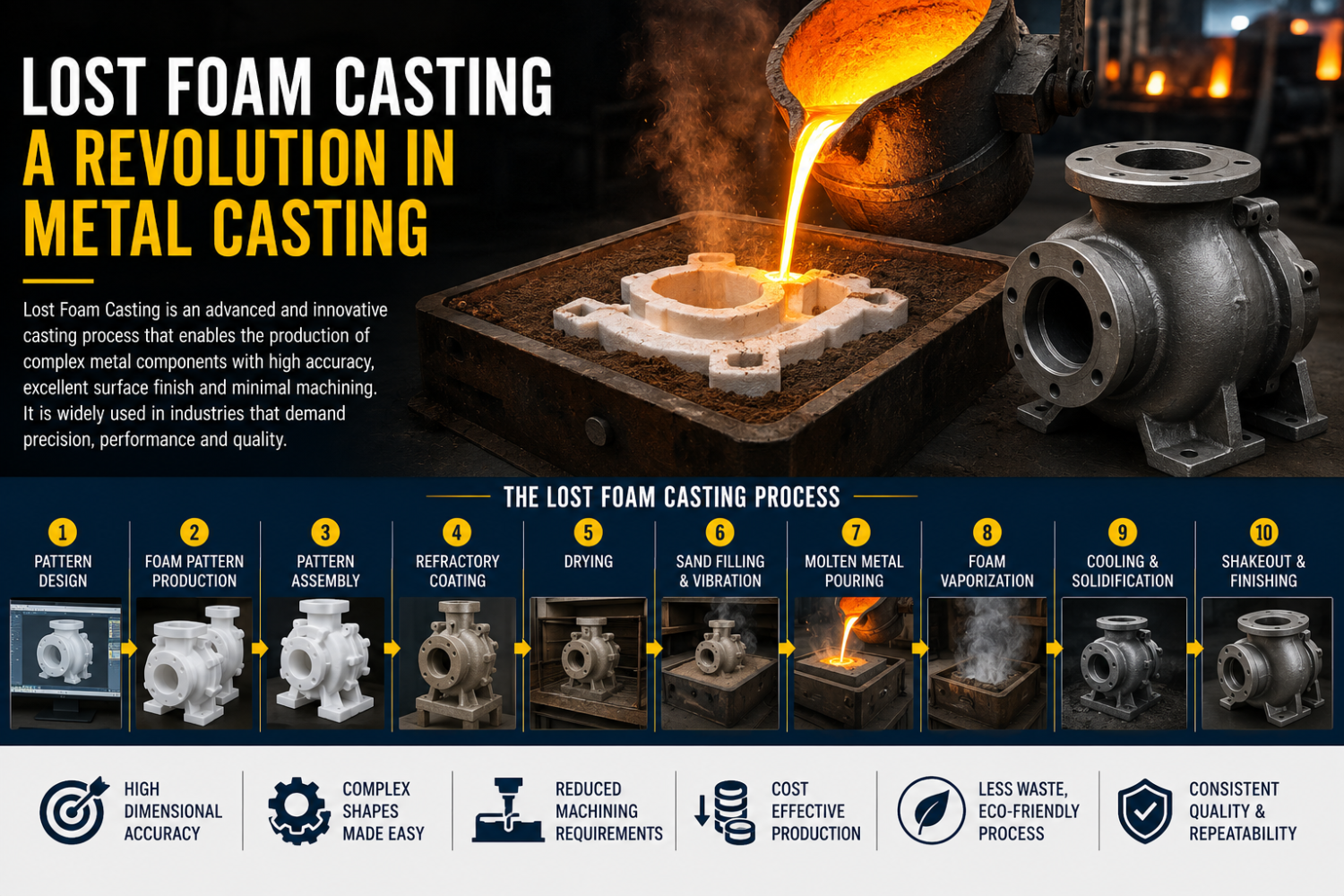
Lost Foam Casting: A Revolution in Metal Casting
Metal casting has been one of the most important manufacturing processes for centuries, enabling industries to produce complex metal components with precision and efficiency. As manufacturing technologies continue to evolve, industries are increasingly looking for casting methods that reduce production costs, improve dimensional accuracy, and simplify the manufacturing process. Among the various casting techniques available today, Lost Foam Casting has emerged as one of the most advanced and reliable solutions for producing complex metal components.
Unlike conventional casting methods that require multiple cores, parting lines, and complex mould assemblies, It uses an expendable foam pattern that is completely replaced by molten metal during the pouring process. This innovative approach allows manufacturers to create highly intricate castings with exceptional accuracy while significantly reducing machining requirements and assembly operations.
Today, this is widely used for manufacturing industrial pump components, valve bodies, automotive parts, power plant equipment, heavy engineering components, and many other precision castings. Its ability to produce complex geometries in a single piece has made it the preferred choice for industries that demand superior quality, consistency, and cost-effective production.
History of Lost Foam Casting
Although metal casting has existed for thousands of years, Lost Foam Casting is a relatively modern innovation. The concept was first developed during the 1950s as manufacturers searched for more efficient ways to produce complex castings without relying on traditional core-making techniques. Over the following decades, improvements in foam pattern production, refractory coatings, and moulding methods transformed the process into a commercially viable manufacturing technology.
The automotive industry played a major role in the development of Lost Foam Casting. As vehicle manufacturers sought lighter, stronger, and more complex engine components, the process proved highly effective for producing engine blocks, cylinder heads, transmission housings, and other intricate castings. Its success in automotive manufacturing soon led to widespread adoption across industrial pumps, valve manufacturing, heavy engineering, mining equipment, and power generation industries.
Today, advances in computer-aided design (CAD), CNC machining, automated moulding systems, and quality inspection technologies have further enhanced the capabilities of Lost Foam Casting. Modern foundries now use the process to manufacture high-precision components that meet stringent international quality standards.
Why Lost Foam Castings is Gaining Popularity
Manufacturers across the world are increasingly choosing Lost Foam Casting because it combines precision, efficiency, and design flexibility. Unlike conventional casting methods, it enables the production of complex components in a single casting, reducing the need for welding, assembly, and excessive machining.
The process also offers excellent dimensional consistency, allowing manufacturers to maintain high quality across both small and large production volumes. Reduced material waste, improved productivity, and shorter manufacturing cycles further contribute to its growing popularity in modern industrial manufacturing.
As industries continue to demand lightweight, high-performance, and cost-effective components, Lost Foam Casting has become an essential technology for producing reliable castings that meet today’s engineering standards.
Contact Crafton Technocast
If you are searching for a reliable Lost Foam Casting manufacturer in India, Crafton Technocast provides high-quality CI and SG Iron castings for industrial applications.
We are committed to delivering precision, quality, and advanced engineering solutions for global industries.
Contact us today for customized industrial casting solutions.
Add comment