
What Is a Valve Body?
The valve body is the main pressure-containing component of an industrial valve. It houses the internal flow passage and provides the structure for components such as the bonnet, disc, seat and stem.
Because the valve body is exposed to pressure and the operating environment, material selection is extremely important.
Valve bodies may be manufactured from materials such as:
- Cast iron
- Ductile iron
- Cast steel
- Stainless steel
- Alloy steels
- Other application-specific alloys
Among these, cast iron and ductile iron are commonly considered for many water, utility and general industrial applications.
What Is Cast Iron?
Cast iron is an iron-based alloy containing a relatively high carbon content. Conventional grey cast iron contains graphite primarily in flake form.
This graphite structure gives cast iron several useful characteristics:
- Good castability
- Good machinability
- Good vibration damping
- Good dimensional stability
- Relatively low material cost
- Good compressive strength
These characteristics make cast iron useful for many industrial components, including valve bodies, pump components, housings and machine bases.
However, the flake graphite structure also creates stress concentrations within the material. As a result, grey cast iron is comparatively brittle and less resistant to impact than ductile iron.
What Is Ductile Iron?
Ductile iron, also known as nodular cast iron or spheroidal graphite iron (SG iron), is an iron casting material in which graphite forms primarily as small nodules rather than flakes.
This microstructure provides a combination of strength and ductility that is valuable for demanding industrial components.
Typical advantages include:
- Higher tensile strength
- Better impact resistance
- Greater ductility
- Better resistance to mechanical shock
- Good castability
- Good machinability
- Strong performance in many pressure-containing applications
Because of these characteristics, ductile iron is widely used for components where higher mechanical performance is required.
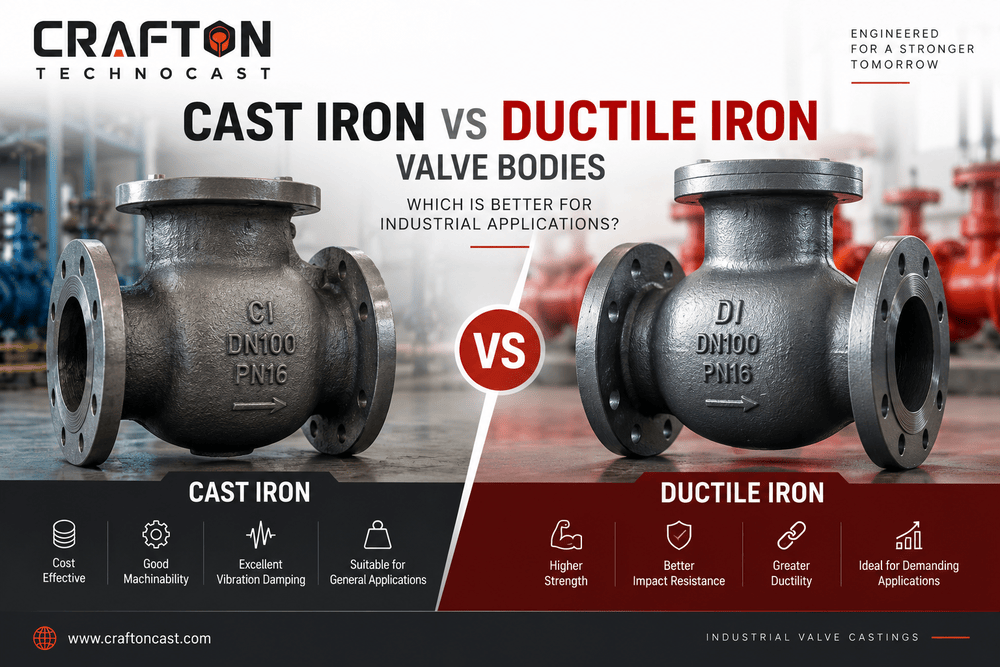
Cast Iron vs Ductile Iron Valve Bodies
The biggest difference between the two materials comes from their graphite structure.
In grey cast iron, graphite is present largely as flakes. In ductile iron, graphite is predominantly present as rounded nodules.
This difference significantly affects how the material responds to mechanical stress.
| Property | Cast Iron Valve Body | Ductile Iron Valve Body |
|---|---|---|
| Graphite structure | Flake graphite | Nodular graphite |
| Strength | Moderate | Higher |
| Ductility | Low | Higher |
| Impact resistance | Lower | Better |
| Vibration damping | Excellent | Good |
| Machinability | Very good | Good |
| Castability | Excellent | Excellent |
| Cost | Generally lower | Generally higher |
| Mechanical shock resistance | Limited | Better |
| Typical applications | General/utility service | More demanding applications |
The exact mechanical properties depend on the specific grade, casting quality, heat treatment and applicable standard.
When Should You Choose Cast Iron Valve Bodies?
Cast iron may be appropriate when the application has relatively moderate mechanical demands and the material meets the required valve standard and pressure-temperature rating.
Potential applications include:
- Water systems
- Utility services
- HVAC systems
- General industrial equipment
- Low-to-moderate duty applications
- Equipment where excellent machinability and cost efficiency are important
The final selection should always be based on the actual operating conditions and relevant standards.
When Should You Choose Ductile Iron Valve Bodies?
Ductile iron becomes particularly attractive when improved strength and toughness are required.
It can be considered for:
- Water distribution systems
- Industrial pipelines
- Pumping systems
- Process equipment
- Infrastructure applications
- Pressure-containing equipment
- Applications exposed to mechanical loads or shock
Its combination of strength, ductility and castability makes it a versatile material for industrial valve components.
Final Verdict: Cast Iron vs Ductile Iron Valve Bodies?
Both materials have an important role in industrial valve manufacturing.
Cast iron is attractive for applications where cost efficiency, castability and machinability are important and where the required mechanical performance is within the material’s specified limits.
Ductile iron offers higher strength, greater ductility and better toughness, making it a strong choice for many applications involving higher mechanical demands.
Ultimately, the best valve body material is the one that meets the pressure, temperature, media, mechanical, dimensional and applicable standard requirements of the specific application.
For OEMs, material selection should be considered together with casting quality, machining accuracy, inspection and process capability.
Why Choose Crafton Technocast?
Crafton Technocast specializes in Lost Foam Casting and precision-engineered industrial cast components.
Our product capabilities include:
Industrial Pump Castings, Industrial Valve Castings, Automotive Casting Components, Pipe Fittings, Fire & Safety Equipment Castings, Pneumatic Components, and Power Plant Equipment Castings.
We work with customer drawings and technical specifications to develop components based on application requirements, material selection, production volume, dimensional requirements, and quality expectations.
Our focus is not simply on producing a casting. It is on finding a manufacturing solution that works for the complete production requirement.
Contact Crafton Technocast
If you are searching for a reliable Lost Foam Casting manufacturer in India, Crafton Technocast provides high-quality CI and SG Iron castings for industrial applications.
We are committed to delivering precision, quality, and advanced engineering solutions for global industries.
Contact us today for customized industrial casting solutions.
Add comment