
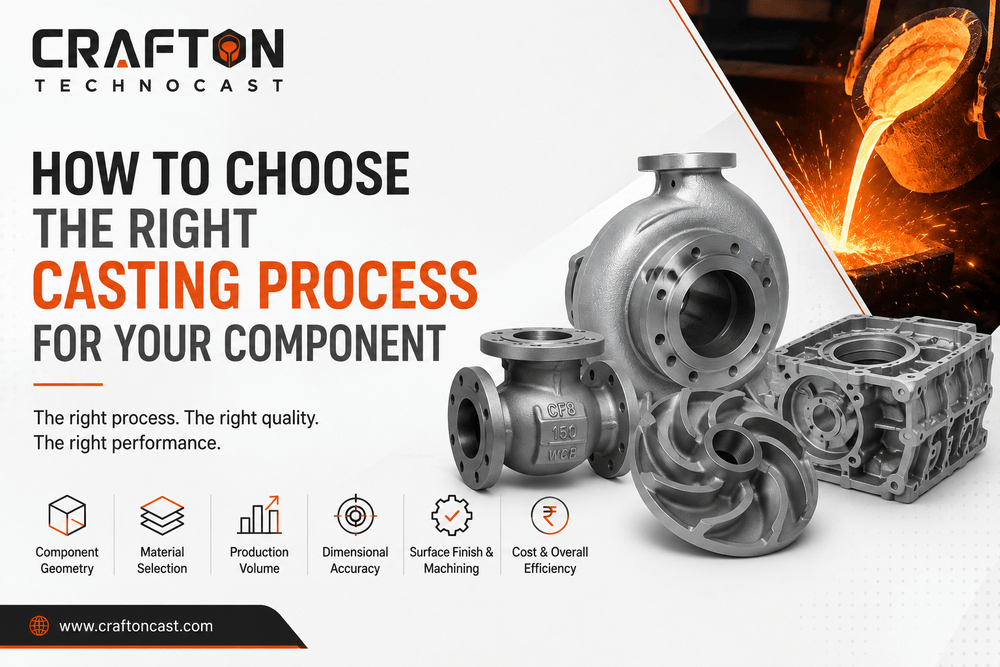
Choosing the right casting process is one of the most important decisions when developing an industrial component. The manufacturing process can affect component quality, production cost, tooling investment, dimensional accuracy, machining requirements, lead time, and long-term performance.
There is no single casting process that is ideal for every component. Sand casting, Lost Foam Casting, investment casting, die casting, and other processes each have different strengths. The right choice depends on the component’s material, size, geometry, production volume, dimensional requirements, surface finish, and budget.
For OEMs and industrial buyers, selecting the process at the beginning of product development can prevent unnecessary tooling costs and machining operations later.
What Is Casting Process Selection?
Casting process selection means choosing the manufacturing method that best matches the requirements of a particular component.
A pump casing, for example, may have large dimensions and complex internal passages. A small precision component may require tighter tolerances and a different casting process. An automotive component produced in large volumes may have completely different requirements.
The objective is not simply to find the cheapest casting method. Instead, manufacturers should evaluate the total manufacturing cost, including tooling, casting, machining, inspection, material utilization, production time, and potential scrap
Factors to Consider When Choosing a Casting Process
1. Component Material
Material is one of the first factors to evaluate.
Different casting processes support different metals and alloys. Sand casting can accommodate a broad range of ferrous and non-ferrous materials, while die casting is commonly associated with aluminium, zinc, and magnesium alloys. Investment casting provides access to a wide range of alloys, including steels and specialty alloys.
For Cast Iron and Ductile Iron components, sand-based processes and Lost Foam Casting can be particularly relevant depending on the component design and production requirements.
2. Component Size and Weight
The size and weight of the component also influence process selection.
Large industrial components such as pump housings, valve bodies, machinery housings, and power equipment components may be more suitable for processes capable of handling larger castings.
Investment and die casting are often selected for smaller, more detailed components, while sand casting can accommodate a much wider range of component sizes.
Lost Foam Casting can also be attractive for medium-to-large components where complex geometry needs to be produced with fewer conventional cores.
3. Component Geometry and Complexity
Complexity is where process selection becomes particularly important.
A component containing internal passages, curved surfaces, undercuts, integrated ribs, cavities, and multiple features can be difficult to manufacture using conventional moulding and core assemblies.
Lost Foam Casting can be advantageous for selected complex components because the foam pattern reproduces the complete component geometry and can reduce the need for conventional cores and parting lines.
4. Production Volume
Production quantity can significantly change which casting process is economical.
For smaller production runs, a process with relatively low tooling investment may be preferable. For very high-volume production, higher tooling costs can become economical if they deliver faster cycle times and lower unit costs.
For example, die casting generally becomes more attractive as production volume increases because its tooling investment can be distributed across a large number of components.
5. Dimensional Accuracy and Tolerance
Tolerance requirements are another major consideration.
If the component can accommodate relatively broad as-cast tolerances, conventional sand casting may provide an economical solution.
If tighter dimensions are required, processes such as investment casting, die casting, or Lost Foam Casting may be considered depending on the geometry and material. Even then, critical dimensions may still require CNC machining.
6. Surface Finish Requirements
Surface finish can influence both component performance and machining requirements.
Some industrial components can accept a standard cast surface followed by machining. Others may require a finer surface finish because of sealing, fluid flow, appearance, or functional requirements.
Investment casting is known for producing relatively fine surfaces, while Lost Foam Casting can provide good surface reproduction for suitable components. Sand casting remains attractive where extensive machining or less demanding surface requirements are acceptable.
When Should You Choose Lost Foam Casting?
Lost Foam Casting deserves consideration when your component combines complex geometry with the need for efficient production.
It can be particularly attractive when the component contains features that would require complicated core assemblies in conventional sand casting.
The process can offer:
- Complex geometry
- Reduced core requirements
- Fewer parting lines
- Near-net-shape production
- Reduced machining requirements
- Good dimensional reproduction
- Integrated component features
However, Lost Foam Casting also requires careful control of foam pattern quality, refractory coating, sand compaction, metal filling, and gas evacuation. Poor process control can lead to defects such as gas-related porosity and inclusions.
Therefore, the technology should be evaluated based on both its advantages and the manufacturer’s process capability.
Why Choose Crafton Technocast?
Crafton Technocast specializes in Lost Foam Casting and precision-engineered industrial cast components.
Our product capabilities include:
Industrial Pump Castings, Industrial Valve Castings, Automotive Casting Components, Pipe Fittings, Fire & Safety Equipment Castings, Pneumatic Components, and Power Plant Equipment Castings.
We work with customer drawings and technical specifications to develop components based on application requirements, material selection, production volume, dimensional requirements, and quality expectations.
Our focus is not simply on producing a casting. It is on finding a manufacturing solution that works for the complete production requirement.
Contact Crafton Technocast
If you are searching for a reliable Lost Foam Casting manufacturer in India, Crafton Technocast provides high-quality CI and SG Iron castings for industrial applications.
We are committed to delivering precision, quality, and advanced engineering solutions for global industries.
Contact us today for customized industrial casting solutions.
Add comment