
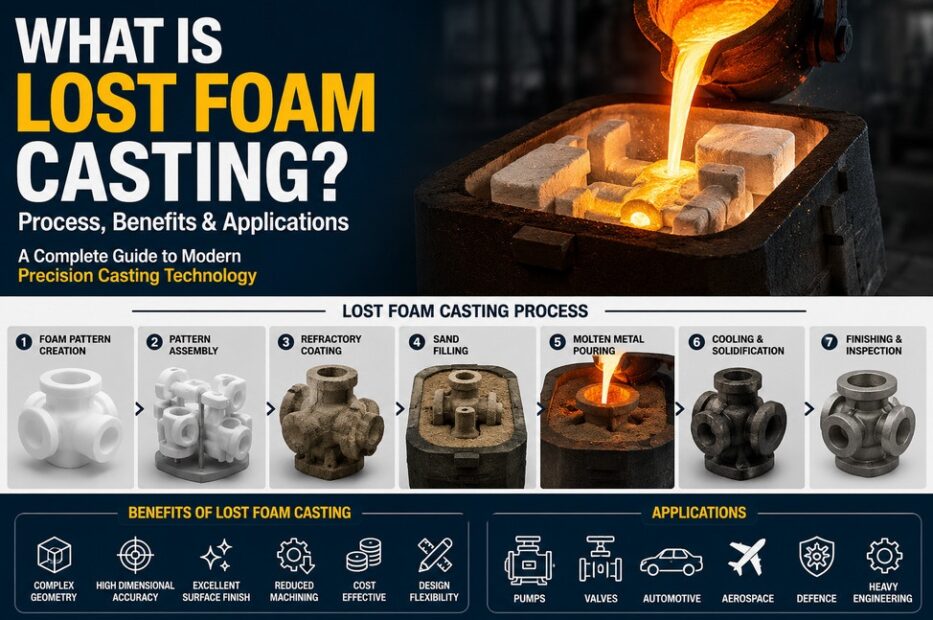
What is Lost Foam Casting?
Lost Foam Casting is an advanced metal casting process used to manufacture complex industrial components with high precision and excellent surface finish. In this process, a foam pattern is created in the exact shape of the final product and coated with refractory material before being surrounded by unbonded sand. When molten metal is poured into the mold, the foam evaporates and the metal takes its shape.
Today, Lost Foam Casting is widely used in industries such as automotive, pumps, valves, aerospace, defence, fire safety, and heavy engineering because of its ability to produce intricate designs with reduced machining requirements.
The growing demand for precision industrial components has made Lost Foam Casting one of the most preferred casting technologies in modern manufacturing.
Lost Foam Casting Process
The Lost Foam Casting process involves several important manufacturing stages to achieve accurate and high-quality cast components.
Lost Foam Casting Process
The Lost Foam Casting process involves several important manufacturing stages to achieve accurate and high-quality cast components.
1. Foam Pattern Creation
The process begins with manufacturing a foam pattern using expanded polystyrene (EPS). This foam pattern represents the exact design and dimensions of the final casting component.
The foam patterns can be created for:
- Valve body castings
- Pump housing castings
- Automotive components
- Industrial machinery parts
- Complex engineering structures
2. Pattern Assembly
Multiple foam patterns are assembled together using special adhesives to create a complete cluster. This helps improve production efficiency and reduces manufacturing costs.
3. Refractory Coating
The foam pattern is coated with a refractory material to improve surface finish and protect the mold during molten metal pouring.
Benefits of refractory coating:
- Better surface quality
- Improved dimensional accuracy
- Reduced casting defects
- Enhanced mold strength
4. Sand Filling
The coated foam pattern is placed inside a flask and surrounded with unbonded sand. The sand provides support and maintains the shape during casting.
Unlike traditional sand casting, Lost Foam Casting does not require cores in many applications.
5. Molten Metal Pouring
Molten metal is poured directly into the mold. As the metal enters the cavity, the foam vaporizes and is replaced by molten metal.
This process creates highly detailed and near-net-shape castings.
6. Cooling and Solidification
After pouring, the casting is allowed to cool and solidify naturally. Proper cooling ensures structural integrity and dimensional stability.
7. Finishing and Inspection
The final casting undergoes:
- Surface cleaning
- Finishing operations
- Dimensional inspection
- Quality testing
This ensures the component meets industrial standards and customer specifications.
Why Industries Prefer Lost Foam Casting
Industries worldwide are increasingly choosing Lost Foam Casting because it improves manufacturing efficiency and component quality.
Major reasons include:
- Precision engineering capability
- Cost-effective production
- Reduced material wastage
- Faster production cycles
- Better product consistency
- Advanced manufacturing flexibility
As industrial designs become more complex, Lost Foam Casting continues to grow as a preferred casting technology.
Contact Crafton Technocast
If you are searching for a reliable Lost Foam Casting manufacturer in India, Crafton Technocast provides high-quality CI and SG Iron castings for industrial applications.
We are committed to delivering precision, quality, and advanced engineering solutions for global industries.
Contact us today for customized industrial casting solutions.


Add comment