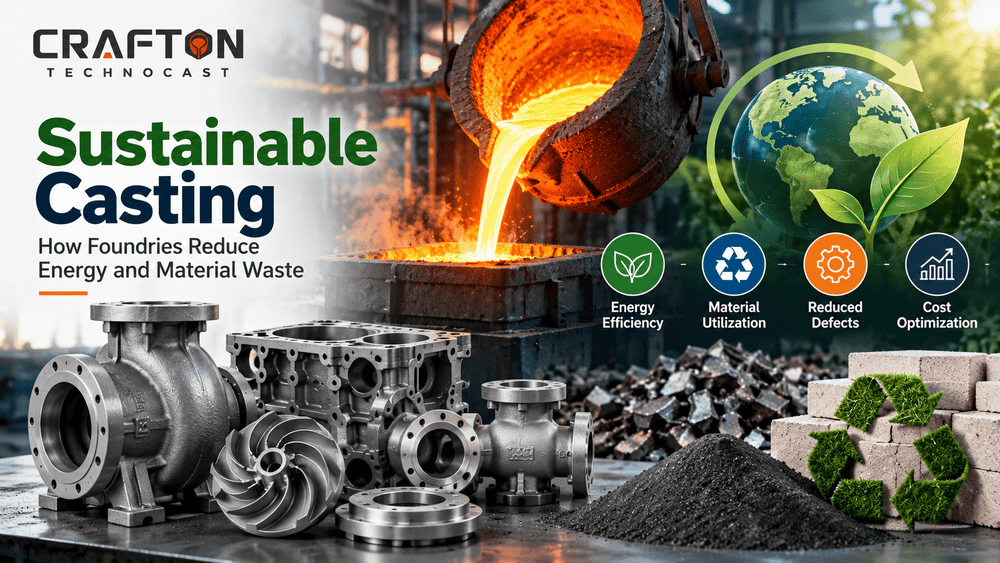
Sustainable casting is becoming increasingly important for foundries that want to improve production efficiency, reduce operating costs, and minimize environmental impact. By optimizing energy consumption, reducing material waste, and improving casting quality, foundries can build more efficient manufacturing processes while meeting the evolving expectations of industrial customers.
For industries such as automotive, pumps, valves, and industrial machinery, sustainable casting practices can also support more responsible sourcing and long-term manufacturing performance.
What Is Sustainable Casting?
Sustainable casting refers to manufacturing practices that reduce the environmental impact of metal casting throughout production. It involves using energy efficiently, minimizing raw material losses, reusing suitable materials, reducing defects, and managing foundry waste responsibly.
Rather than focusing only on the final component, sustainable casting considers the complete process—from material preparation and mold production to casting, finishing, machining, and quality inspection.
Improving Energy Efficiency in Foundries
Melting and heating operations can consume significant amounts of energy in foundry production. Improving furnace efficiency and controlling operating conditions can help reduce energy consumption.
Foundries can improve energy efficiency by:
Maintaining furnaces and production equipment regularly.
Optimizing melting temperatures and production schedules.
Reducing unnecessary furnace idling and heat loss.
Monitoring energy consumption per production batch.
Improving insulation and heat-management practices.
These measures can help reduce operating costs while supporting more efficient production.
Reducing Material Waste During Casting
Material utilization plays an important role in sustainable casting. Excess material, rejected components, and inefficient casting designs can increase raw material consumption and production costs.
Foundries can reduce material waste by optimizing casting design, controlling pouring practices, and improving process consistency. Proper planning of gates, runners, and risers can also help improve metal utilization, depending on the casting process and component design.
Accurate production planning and careful handling of raw materials further reduce avoidable losses.
Preventing Casting Defects and Rejections
Casting defects such as porosity, shrinkage, inclusions, and dimensional inaccuracies can result in rejected components, additional machining, and wasted resources.
Preventive measures include:
Reviewing component drawings before production.
Selecting suitable casting processes and mold designs.
Controlling material quality and process parameters.
Inspecting components at appropriate production stages.
Investigating recurring defects and implementing corrective actions.
Reducing rejection rates helps conserve materials, energy, labor, and machine time.
Reusing Materials and Managing Foundry Waste
Where technically suitable, foundries can reuse recovered metal through controlled remelting and recycling practices. Sand and other process materials may also be reclaimed or reused when their condition and applicable quality requirements permit.
Effective waste management includes segregating different materials, monitoring waste generation, and ensuring that waste requiring specialized treatment is handled appropriately.
Recycling and reuse should always follow suitable material-quality controls so that sustainability efforts do not compromise component performance.
Using Casting Design to Improve Efficiency
Good component design can contribute significantly to sustainable manufacturing. Design reviews can identify opportunities to reduce unnecessary material, simplify geometries, and improve manufacturability.
Depending on the component, casting simulation and engineering analysis may help identify potential filling or solidification problems before production begins. This can reduce trial runs, avoidable rework, and material loss.
Collaboration between customers and foundry engineers during the design stage can help balance component performance, manufacturability, and cost.
How Sustainable Casting Benefits Industrial Buyers
Sustainable casting practices can benefit both foundries and their customers. Better material utilization and fewer defects may reduce production costs, while consistent process control can improve product quality and delivery reliability.
For OEMs and industrial buyers, working with a casting supplier that prioritizes process efficiency and quality control can support more responsible sourcing decisions. Buyers should evaluate actual production capabilities, quality systems, material traceability, and documented environmental performance rather than relying on sustainability claims alone.
Why Choose Crafton Technocast?
Crafton Technocast specializes in Lost Foam Casting and precision-engineered industrial cast components.
Our product capabilities include:
Industrial Pump Castings, Industrial Valve Castings, Automotive Casting Components, Pipe Fittings, Fire & Safety Equipment Castings, Pneumatic Components, and Power Plant Equipment Castings.
We work with customer drawings and technical specifications to develop components based on application requirements, material selection, production volume, dimensional requirements, and quality expectations.
Our focus is not simply on producing a casting. It is on finding a manufacturing solution that works for the complete production requirement.
Contact Crafton Technocast
If you are searching for a reliable engine block casting manufacturer in India, Crafton Technocast provides high-quality CI and SG Iron castings for industrial applications.
We are committed to delivering precision, quality, and advanced engineering solutions for global industries.
Contact us today for customized industrial casting solutions.
Add comment