
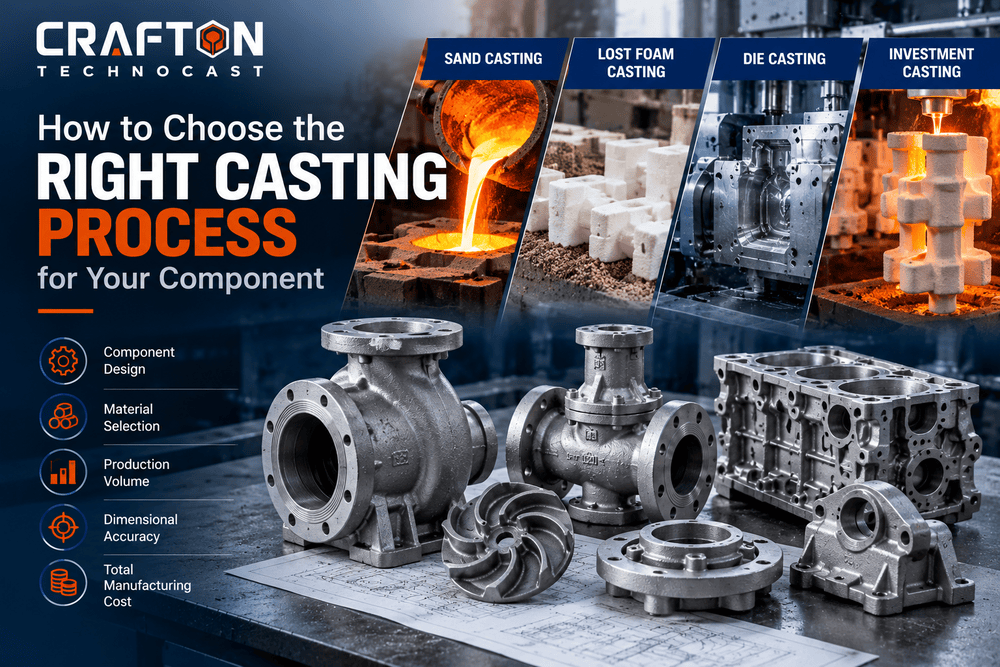
What Is a Casting Process?
Casting is a manufacturing method in which molten material is poured into a mold to produce a component of the required shape.
Different casting processes are suitable for different applications. The right choice depends on the component design, material properties, production volume, quality requirements and overall manufacturing cost.
Common Types of Casting Processes
1. Sand Casting
Sand Casting uses a sand-based mold to produce metal components.
It is commonly used for industrial pump housings, valve bodies, machine components and other cast parts.
Key advantages:
Suitable for a wide range of component sizes
Supports different casting geometries
Flexible for various production quantities
Can accommodate several ferrous and non-ferrous alloys, depending on the process
2. Lost Foam Casting
Lost Foam Casting uses a foam pattern that is displaced during metal pouring to form the component.
It can be suitable for complex industrial components with intricate shapes and internal features.
Key advantages:
Suitable for complex geometries
Reduced parting lines
Reduced core requirements for suitable designs
Potential to reduce machining requirements
Applications may include selected pump components, valve bodies, automotive parts and industrial housings.
3. Die Casting
Die Casting forces molten metal into a reusable metal mold under pressure. It is commonly used for suitable non-ferrous alloys, particularly aluminium and zinc.
Key advantages:
High production rates
Good repeatability
Good dimensional consistency
Suitable for high-volume production
The tooling investment can be substantial, so the process is generally most attractive when production volumes justify it.
4. Investment Casting
Investment Casting uses a disposable pattern and ceramic mold to produce components with fine details and complex shapes.
It is commonly considered for components requiring intricate geometry and good dimensional accuracy.
The process may involve higher tooling and processing costs than some alternatives, depending on the component.
Factors to Consider When Selecting a Casting Process
1. Component Design and Complexity
Components with complex geometries, internal passages or intricate features may require specialized mold and core arrangements.
Review the component drawing to determine which process can produce the required shape efficiently.
2. Material Requirements
The casting process must be compatible with the specified material.
Depending on the process, materials may include cast iron, ductile iron, cast steel, aluminium alloys and other suitable metals.
Material selection should consider the component’s mechanical properties, operating environment and applicable standards.
3. Production Volume
Production quantity affects tooling cost and manufacturing efficiency.
Low-volume production: Flexible processes such as Sand Casting may be suitable.
Medium-volume production: The choice depends on geometry, material, tooling and unit cost.
High-volume production: Die Casting or other automated processes may be economical for suitable components.
These are general guidelines; the best option depends on the specific part.
4. Dimensional Accuracy and Surface Finish
Some components require precise dimensions, smooth surfaces or minimal machining.
Evaluate the casting process alongside the finishing operations needed to meet the final drawing specifications.
5. Machining Requirements
Casting produces the basic shape, while machining creates critical features such as bores, threads, mounting surfaces and sealing areas.
A suitable casting process can help provide appropriate machining allowances and reduce unnecessary material removal.
6. Total Manufacturing Cost
The lowest casting price does not always mean the lowest finished-component cost.
Consider the complete cost, including:
Tooling and pattern development
Casting production
Material usage
Machining
Inspection
Rework and rejection
Transportation
Why the Right Casting Partner Matters
Selecting a casting process requires an understanding of component geometry, material specifications, production requirements and quality expectations.
An experienced casting partner can review the drawing, evaluate suitable manufacturing methods and identify potential machining or quality challenges before production begins.
At Crafton Technocast, we support industrial component requirements with Lost Foam Casting, Sand Casting and machining capabilities for suitable applications, including pump castings, valve bodies, automotive components and pneumatic components.
Conclusion
Choosing the right casting process helps balance component complexity, material requirements, dimensional accuracy, production volume and total manufacturing cost.
Sand Casting, Lost Foam Casting, Die Casting and Investment Casting each offer different advantages. The best process depends on the component’s specifications and intended application.
For OEMs, reviewing the casting process early can help improve manufacturability and achieve consistent component quality.
Why Choose Crafton Technocast?
Crafton Technocast specializes in Lost Foam Casting and precision-engineered industrial cast components.
Our product capabilities include:
Industrial Pump Castings, Industrial Valve Castings, Automotive Casting Components, Pipe Fittings, Fire & Safety Equipment Castings, Pneumatic Components, and Power Plant Equipment Castings.
We work with customer drawings and technical specifications to develop components based on application requirements, material selection, production volume, dimensional requirements, and quality expectations.
Our focus is not simply on producing a casting. It is on finding a manufacturing solution that works for the complete production requirement.
Contact Crafton Technocast
If you are searching for a reliable engine block casting manufacturer in India, Crafton Technocast provides high-quality CI and SG Iron castings for industrial applications.
We are committed to delivering precision, quality, and advanced engineering solutions for global industries.
Contact us today for customized industrial casting solutions.
Add comment