
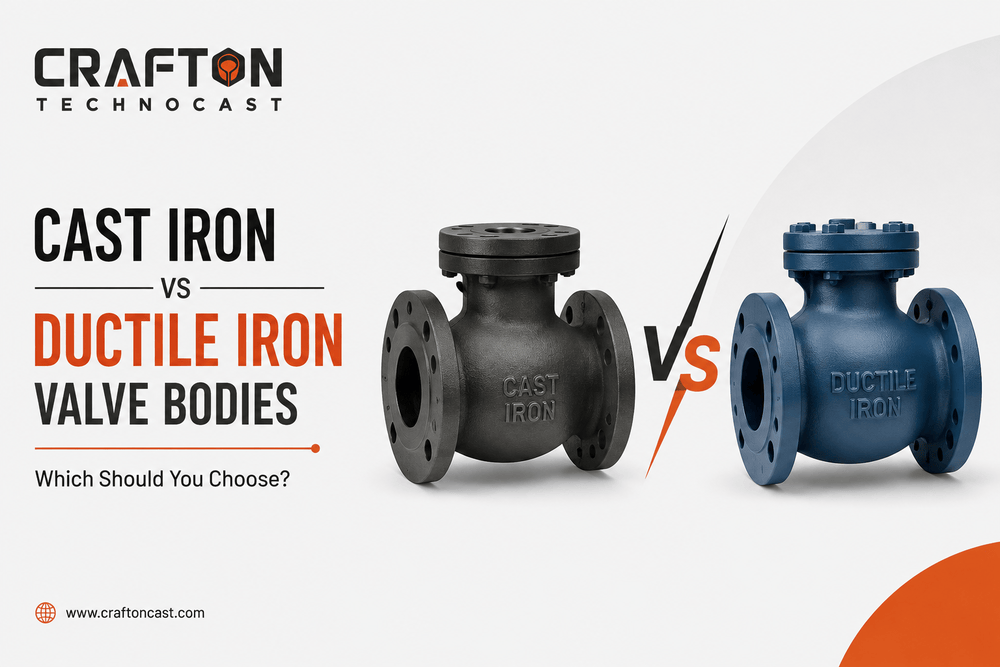
Cast Iron vs Ductile Iron Valve Bodies: Which Should You Choose?
Choosing the right material for a valve body can have a major impact on the performance, reliability, service life, and overall cost of an industrial piping system. Cast iron and ductile iron valve bodies are both widely used, but they have different mechanical characteristics and are suited to different operating conditions.
Cast iron has been used for valve bodies for many years because of its good castability, cost-effectiveness, and suitability for many general-purpose applications. Ductile iron, also known as nodular iron or spheroidal graphite iron, offers greater ductility and impact resistance because of its graphite-nodule structure.
So, which one should you choose? The answer depends on the pressure, temperature, fluid, mechanical loading, application, required service life, and applicable valve standard.
What Is a Cast Iron Valve Body?
A cast iron valve body is produced from grey cast iron and is commonly selected for general-purpose valve applications where the operating conditions are within the material’s specified limits.
Cast iron offers good castability and vibration-damping characteristics, making it suitable for many water, HVAC, irrigation, and general industrial applications. It can also provide an economical solution where extreme impact resistance is not a primary requirement.
However, grey cast iron is relatively brittle compared with ductile iron. Under significant impact or shock loading, it can be more susceptible to cracking. This is an important consideration when selecting a valve body for demanding service.
What Is a Ductile Iron Valve Body?
A ductile iron valve body is manufactured from spheroidal or nodular graphite iron. The graphite morphology gives the material greater ductility and toughness than conventional grey cast iron.
This makes ductile iron attractive for applications where the valve may experience higher mechanical loads, pressure fluctuations, vibration, or impact. Ductile iron is widely used in water distribution, wastewater, pumping systems, and industrial applications.
Cast Iron vs Ductile Iron Valve Bodies: Key Differences
The main difference between the two materials is their mechanical behaviour.
Grey cast iron is rigid and economical, but its lower ductility means it is less tolerant of impact and sudden mechanical loading. Ductile iron provides greater toughness and resistance to deformation or fracture under many mechanical loading conditions.
This difference becomes particularly important when valve bodies are installed in large pipelines, pumping stations, water infrastructure, or systems where pressure and mechanical loads can vary.
However, material selection should never be based on strength alone. The complete valve design, pressure class, temperature, fluid, trim, sealing system, applicable standard, and installation conditions must all be considered.
Which Is Better: Cast Iron or Ductile Iron?
There is no single answer because the best material depends on the application.
Cast iron may be the better choice when:
The application has moderate operating conditions, impact loads are limited, and cost efficiency is a major consideration.
Ductile iron may be the better choice when:
The valve requires greater toughness, improved resistance to mechanical shock, or higher mechanical performance within the applicable design and pressure rating.
For many modern water and industrial applications, ductile iron has become an increasingly attractive choice because of its combination of strength, toughness, castability, and cost effectiveness. Current industry analysis also indicates that ductile iron has increasingly replaced grey cast iron in many butterfly-valve body applications where greater impact resistance and pressure capability are required.
Why Choose Crafton Technocast for OEM Castings?
Crafton Technocast provides precision-engineered casting solutions for industrial applications, including industrial valve castings and valve body components.
Our capabilities include Lost Foam Casting, custom casting development, machining, dimensional inspection, and material-focused quality control. We work with customer drawings and technical specifications to develop components for demanding industrial applications.
Our casting solutions can support applications across water infrastructure, industrial pumping, fire protection, power generation, pneumatic systems, and other engineering industries.
For OEM requirements, our focus is on consistent production, dimensional accuracy, material control, and reliable component quality.
Contact Crafton Technocast
If you are searching for a reliable Lost Foam Casting manufacturer in India, Crafton Technocast provides high-quality CI and SG Iron castings for industrial applications.
We are committed to delivering precision, quality, and advanced engineering solutions for global industries.
Contact us today for customized industrial casting solutions.
Add comment